

Get ready for 2027
Slalom’s Tiered Racing Structure
In November 2025, after extensive consultation, the sport agreed to move to a new structure for canoe slalom racing from the start of the 2027 season. Work has been going on throughout this year to prepare the systems that run the sport for this significant change.
We now want to make sure the whole slalom community has the information they need to understand and be ready for racing in 2027. We now have a short explainer video and the overview below, plus a lot of FAQ’s to answer your questions. You can also ask a questions at one of our webinars, at an event, or via our Questions Form.
Whether you are a paddler, parent, coach, official or club volunteer we ask everyone in the slalom community to make time to read the information below and the FAQs so you are ready to race in 2027.
Core Principles of the Tier Structure
Racing by Tier rather than by Division
Competitions will now by Tier (based on water and course difficulty), not by the ranking division. The tiers are Diamond & Black (Expert), Red & Blue (Advancing), Green & Taster (Novice).
Benefits:
- Competitors are given unprecedented freedom of choice. The restriction on only entering your division or “Paddling Up” are entirely removed. A competent Division 3 paddler can now attend a Red Tier event (challenging white water) to test themselves without any prior promotion. Conversely, a Division 2, or even Premier, paddler can race at a Green Tier event (local, social) and still get performance-based points.
- A paddler promoted on Saturday can still compete on Sunday. This flexibility caters equally to the athlete aiming for rapid progression and the club paddler prioritizing the social and family elements of the weekend, ensuring they can race alongside their friends regardless of individual ranking status.
Retention of Divisions
Divisional ranking is retained (Premier, 1, 2, 3, Veterans) but is used exclusively for ranking, not for restricting entry to competitions.
Benefits:
- Our consultation with juniors was very clear that divisions and promotion is a vital goal-setting mechanism that should be retained. Therefore, the familiar structure that guides an athlete’s development, encourages long-term engagement and provides clear competitive benchmarks against similar-ability peers is retained.
- While divisions are retained, they are no longer linked to restricting race or venue attendance.
A fairer, Performance-Based Points
A new points calculation system is introduced. Points are now calculated based on the athlete’s time gap to the winner and the Tier Factor, eliminating dependence on the number of people in the race. The new method of calculating the maximum points available for the winner of a race takes into account the proficiency of the competitors attending as well as the Tier of the race. This means that lower division paddlers are not penalised by the attendance of someone from a higher division at a lower tier race.
Benefits:
- This creates fairer competition. The current divisional system awards points based on positional placement and competitor count, which means a paddler finishing 0.5 seconds behind a winner in a small field is often harshly penalised compared to someone who finishes further back in a large field. The proposed system is time-relative: a good performance and narrow time gap guarantees a high points score proportional to the Tier’s difficulty, regardless of whether 5 or 50 athletes were present.
- This innovation renders the entire concept of a race being “inquorate” (less than 5 competitors) irrelevant for points calculation. This removes a major source of competitor frustration by ensuring a competitor’s effort and skill are accurately reflected regardless of the number of competitors.
- It reduces also the organising club’s anxiety regarding numbers racing as paddlers will no longer feel the need to delay entry until they see an event is quorate.
Questions about Racing in 2027
We know there are lots of questions about the new structure, how it will work and what it means for paddlers and organising clubs. We have put together some Frequently Asked Questions (updated 8 October 2026).
Please read these to see if we have answered the questions that you have.
Ask a Question
We know you may have additional questions – if there is something we haven’t covered, please submit your questions here. We’ll use your questions update the FAQs regularly, or we’ll point you to an existing answer if that explains it.
2027 Canoe Slalom Rules
The rules for the new racing structure are published here.
An updated 2027 rulebook reflecting changes at this year’s Salalom ACM will be published in December 2026.
2027 Race Calendar
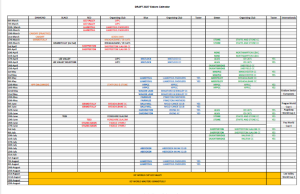
The draft calendar of tiered races is available here: DRAFT 2027 Slalom Calendar.
As usual this drafts and will be approved at the Slalom ACM on 28th November before it becomes final.
How else can I find out more about racing in 2027?
At events – we will have volunteers available at the following events this year for you to ask about the tiered racing structure: Stone 3/4 (3&4 Oct) Llandysul 1/2 (10&11 Oct), Tees P/1 (17&18 Oct), Scottish Championships (7 Nov).
Online Q&A sessions – over the winter we’ll be running several online Q&A sessions to help everyone understand the changes and ask any questions they may have. Dates will be publicised via the website and social media.
Email – after the end of the season, we’ll be emailing all ranked paddlers about the changes
Social Media – we’ll be using our Facebook and Instagram feeds to highlight the key changes and re-post some of the FAQs over the winter.
2027 Slalom rules
The rules for the new racing structure are published here. While everyone is encouraged to read the full rules, as a shortcut, the rules most relevant to the structure changes are:
- Rule 5.1 – Competition Format (UK),
- Rule 6.6 – Performance Points Calculation (UK)
- Rules 22.1 – Competition / Managed Calendar
- Rule 22.8 – Competition Prizes
There are number of motions going to the 2026 Slalom ACM to clarify and refine the rules due to questions that have arisen during the year as we’ve worked towards implementing the tiered structure. An updated 2027 rulebook reflecting changes at the ACM will be published in December 2026.